
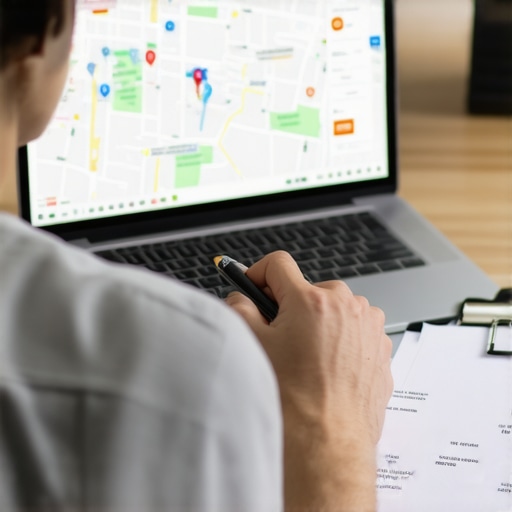
5 Simple Steps to Audit Your Google Maps Presence for Better Visibility
In the high-stakes world of local search, visibility isn’t just a vanity metric – it is the difference between a phone that rings off the hook and a silent office. I am Ren L., a Local SEO Specialist, and I’ve spent the better part of my career helping businesses claw their way out of digital obscurity. Most businesses today have a profile, but they are effectively “invisible” to their target audience. They sit on page three or four of the Map Pack, while their competitors reap 80% of the local leads. If you want to dominate your local market in 2026, a rigorous google business profile seo audit is your first and most critical step toward dominance.
The “Map Pack” – those top three listings that appear at the top of a Google search – is the lifeblood of local lead generation. When someone searches for a service “near me,” they aren’t looking for a website; they are looking for a solution they can call or drive to immediately. If you aren’t in those top spots, you don’t exist. Over the next 2,000 words, I am going to pull back the curtain on my personal auditing process. This isn’t a surface-level checklist; it is a deep-dive manual designed to help you identify exactly where your profile is leaking authority and how to plug those holes to rank google business profile higher than ever before.
The Three Pillars of Google Maps Ranking in 2026
Before we dive into the steps, we must understand the “why” behind the “how.” The Google Maps algorithm is complex, but it fundamentally rests on three pillars: Proximity, Relevance, and Prominence. In 2026, these factors have evolved. Proximity remains the hardest factor to “fix” – you are where you are – but Google has become much more sophisticated at understanding the nuances of service areas versus physical storefronts. Relevance is about how well your profile matches the searcher’s intent, and Prominence is a measure of how much the internet “trusts” your business based on reviews, citations, and backlinks.
A successful audit focuses on the levers you can actually pull. While you can’t easily move your office three miles closer to the city center, you can drastically improve your relevance and prominence. This is where most business owners fail; they treat their profile as a static “set-it-and-forget-it” listing. To win today, you need active management and the right local seo ranking tools to monitor how these three pillars are shifting in real-time. Local SEO is no longer about just having a profile; it’s about proving to Google every single day that you are the most relevant and prominent answer to a user’s query.
Data tells us that proximity is often the “tie-breaker,” but if your relevance and prominence scores are high enough, you can “out-rank” businesses that are physically closer to the searcher. This is the goal of our audit. We are looking for every possible optimization point that signals to Google that you are a high-authority entity. By utilizing a high-level google maps ranking service mindset, we can transform a stagnant profile into a lead-generating machine.
Step 1: The NAP & Core Information Integrity Check
The foundation of any google business profile seo strategy is the integrity of your core data: Name, Address, and Phone Number (NAP). It sounds basic, but you would be shocked at how many multi-million dollar companies have conflicting information floating around the web. Google’s algorithm is essentially a giant “trust engine.” If your profile says you are at “123 Main St Ste 4,” but your Yelp page says “123 Main Street #4,” and your website lists a different tracking number, Google’s “trust” in your data drops. When trust drops, rankings drop.
During this stage of the audit, I look for “ghost” listings or duplicate profiles. Duplicate listings are ranking killers; they split your “ranking juice” and confuse the algorithm. You must ensure that there is only one authoritative profile for your location. Furthermore, check your business name. Are you adding unnecessary keywords to it? While “Plumber Pros of Chicago” might sound like a good idea for SEO, if your legal name is just “Plumber Pros,” you risk a suspension. Google is cracking down on “keyword stuffing” in business names more than ever in 2026.
Consistency extends beyond your profile to every corner of the web. This is why Why Most Local SEO Pricing is a Total Scam for Corporate Vendors is such a relevant topic; many agencies charge thousands of dollars for simple NAP cleanup that can be automated or handled with the right tools. Don’t pay for “magic” when what you need is meticulous data hygiene. Google’s own advice is clear: “Make sure your business info is as complete as possible.” This includes your hours of operation, your service area radius, and your attributes (like “wheelchair accessible” or “women-owned”). Every empty field is a missed opportunity to build relevance.
Step 2: Primary and Secondary Category Optimization
If I had to pick the #1 reason a business isn’t showing up in the Map Pack, it’s usually an issue with their categories. Your **Primary Category** carries the most weight in the algorithm. If you are a “Personal Injury Lawyer” but your primary category is set to “Law Firm,” you are competing against every divorce lawyer and corporate attorney in the city. You are diluting your relevance.
To audit this properly, you need to look at what your top three competitors are doing. I often use a google business profile audit tool to extract the hidden secondary categories that competitors are using. Google allows you to select one primary category and up to nine secondary categories. The strategy here is not to list every possible thing you do, but to select the categories that align with your highest-margin services and have the highest search volume. For example, a HVAC company should have “HVAC Contractor” as the primary, but “Air Conditioning Repair Service” and “Heating Contractor” as essential secondaries.
Actionable Tip: Don’t just set your categories and forget them. Seasonality matters. If you are a landscaping company that does snow removal in the winter, your primary category should reflect that shift in search intent during the colder months. This level of granular management is what separates the experts from the amateurs. By refining your categories, you are telling Google exactly which “buckets” you belong in, making it infinitely easier for the algorithm to serve your profile to the right users at the right time.
Step 3: The Review & Reputation Velocity Audit
Reviews are the “social proof” that the Google algorithm craves. However, in 2026, simply having a 4.5-star rating isn’t enough to rank google business profile in a competitive market. We now look at “Review Velocity” – the rate at which you are getting new reviews – and “Review Sentiment.” If your last review was from six months ago, Google views your business as potentially stagnant or less relevant than a competitor getting three reviews a week.
During your audit, look at your response rate. Are you responding to every review? In 2026, customers and Google both expect a response within 24 hours. Responses should be professional, but they should also be strategic. Keywords in reviews and your responses act as massive ranking signals. If a customer says, “Ren is the best plumber in Chicago,” and you respond with, “Thank you! We take pride in being a top-rated plumber in Chicago,” you are reinforcing your relevance for that specific keyword. This is a subtle but powerful way to rank higher on google maps.
Also, pay attention to the “Review Snippets” that Google displays in the search results. These are often pulled from the text of your reviews. If you want to rank for “emergency roof repair,” you need reviews that specifically mention that service. Encourage your customers to be specific in their feedback. A profile with 500 generic “Great service!” reviews will often be outranked by a profile with 100 detailed reviews that mention specific services and locations. This is the “Prominence” pillar in action.
Step 4: Visual Content & Engagement Signals
Google Maps is becoming increasingly visual. An audit of your photos and Google Posts is non-negotiable. Data shows that profiles with more than 100 photos receive 520% more direction requests and 1,000% more website clicks than those with fewer. Why? Because photos are an engagement signal. When a user spends time scrolling through your photos, they are telling Google that your profile is interesting and relevant. This triggers a positive feedback loop in the algorithm.
Check the quality of your images. Are they high-resolution? Do they show the exterior of your building (which helps with the “Proximity” trust factor)? Do they show your team in action? Also, audit your Google Posts. These are mini-ads that appear on your profile. If your last post was from 2022, your profile looks “dead.” I recommend at least one post per week to keep the engagement signals high. Think of your profile as a storefront; a stale, dusty window doesn’t attract customers. In fact, you can see 5 Reasons Your 2026 Corporate Entertainment Isn’t Closing Leads to understand how “invisible” or unengaging content can kill conversions in any industry.
To really push the needle, ensure you are utilizing google maps optimization techniques like geotagging your images (where appropriate) and using relevant alt-text. While Google’s AI can now “see” what is in an image, providing clear metadata still helps. Your visual content should tell a story of a busy, successful, and local business. This builds the “Prominence” needed to dominate the local map pack seo landscape.
Step 5: Technical Local SEO & Competitor Benchmarking
The final step of the audit is the most technical. You need to know exactly where you rank – not just in your office, but at every street corner in your service area. Rankings on Google Maps are hyper-local. You might be #1 when standing in your lobby but #10 when standing two blocks away. This is why using a google maps rank tracker with geo-grid capabilities is essential. A geo-grid shows you a map with “pins” indicating your rank at specific latitude and longitude points.
If you see that your rankings drop off sharply to the North, you know you need to build more “local relevance” in that specific area. This can be done through local backlinks, city-specific landing pages on your website, or even targeted Google Posts. You also need to understand How to See Exactly Why Local Competitors Outrank You on Google Maps. Are they getting more reviews? Do they have a higher “Domain Authority” on their main website? Your GBP doesn’t exist in a vacuum; the SEO health of your website directly impacts your Map Pack rankings.
Finally, look at your “Insights” (now called Performance Reports). Track your KPIs: Calls, Website Visits, and Direction Requests. If your impressions are high but your clicks are low, you have a “relevance” or “reputation” problem. If your clicks are high but calls are low, your profile isn’t “closing” the lead. A professional gmb ranking service doesn’t just look at the rank; they look at the conversion. By benchmarking yourself against the top players using rank google business profile software, you can create a roadmap to overtake them. Technical local SEO is about finding the 1% gains that add up to a 100% increase in leads.
Conclusion: Turning Your Audit Into a Lead Machine
Auditing your google business profile seo is not a one-time event; it is a recurring necessity in the fast-paced world of 2026 search. By systematically checking your NAP integrity, optimizing your categories, boosting your review velocity, enhancing your visual content, and benchmarking your technical performance, you move from “guessing” to “dominating.”
The Map Pack is the most valuable real estate on the internet for local businesses. Don’t leave your visibility to chance. If you’ve followed these steps and still find yourself struggling to break into the top three, it may be time for a professional intervention. Stop being invisible and start being the first choice for your customers. Feel free to connect with me, Ren L., on LinkedIn, where I share daily insights on how to turn your Google Maps presence into a non-stop lead machine.